The Future Homes Standard is finally here. Here's what it means for hot water.
The Future Homes Standard was laid today. Low carbon heating, tighter fabric, mandatory renewables, and significantly upgraded ventilation. All taking effect from March 2027.
The heat pump headline will get most of the attention. Gas and oil are effectively ruled out under the new Part L energy efficiency requirements, and heat pumps are now the baseline for new homes. That direction has been clear for some time. Most of the industry is already there or getting there.
What deserves closer attention is Part F, the ventilation standard. That’s where the long-term building performance implications are most significant, and where the gap between a compliant home and a genuinely healthy one will be decided.
Hot water sits closer to the centre of these changes than it might appear. The shift to electric heating, mandatory solar PV, and incoming smart appliance requirements under SSES all have direct implications for how hot water systems are specified and controlled. And through our Smart Home Energy Management trial with St Basils, Mixergy has gone a step further, creating a practical link between hot water control and indoor air quality management that the standard identifies as important but stops short of prescribing.
Ventilation standards now have real teeth
Part F 2026 introduces a considerably more prescriptive framework. Whole dwelling ventilation rates are set at 0.3 litres per second per m² of internal floor area, with minimum rates defined by bedroom count. Extract rates for kitchens, bathrooms, and utility rooms are clearly specified for both intermittent and continuous systems.
Mechanical ventilation with heat recovery, known as MVHR, is now subject to tighter performance requirements. Units must achieve a minimum 73% heat recovery efficiency, include summer bypass, and meet Class U4 leakage standards under BS EN 13141-8. For those specifying or procuring these systems, that raises the bar on product selection and installation quality considerably.
Commissioning requirements have also been tightened. Installers must now sign off a formal completion checklist covering visual inspection, duct integrity, and system performance.
Air quality: identified but not fully resolved
Section 2 of Part F sets out requirements for minimising ingress of external pollutants where dwellings are near road traffic, combustion plant, or industrial sources. Appendix B goes further, establishing indoor air quality performance criteria drawn from World Health Organisation guidelines, covering carbon monoxide, nitrogen dioxide, formaldehyde, and total volatile organic compounds. These are not aspirational targets. They are the performance criteria the ventilation provisions are designed to deliver against.
The standard acknowledges that fixed-rate, always-on ventilation is not optimal in polluted environments, and that intakes may need to be managed dynamically during peak pollution periods. It stops short of prescribing how. That gap is significant.
For social housing providers, this matters in a very practical way. Awaab’s Law, which places direct legal obligations on landlords to investigate and remediate damp and mould within set timeframes, means ventilation performance is no longer just a specification question. It is a compliance and liability question.
Mixergy is currently trialling a Smart Home Energy Management system with St Basils, a charity housing association, across both new-build and retrofit homes. The system brings hot water, heating, ventilation, and tariff control under a single intelligent platform, with sensors measuring temperature, humidity, and CO2 to modulate ventilation according to mould risk and occupancy in real time. Early results show a reduction in household energy use of over 30%, with tenants saving around £200 per year. Automated compliance records are also reducing landlord reporting time by over 50% in early deployments.
For housing providers managing large portfolios under increasing regulatory pressure, that combination of health outcomes and operational efficiency is meaningful.
Solar PV and the case for integrated energy management
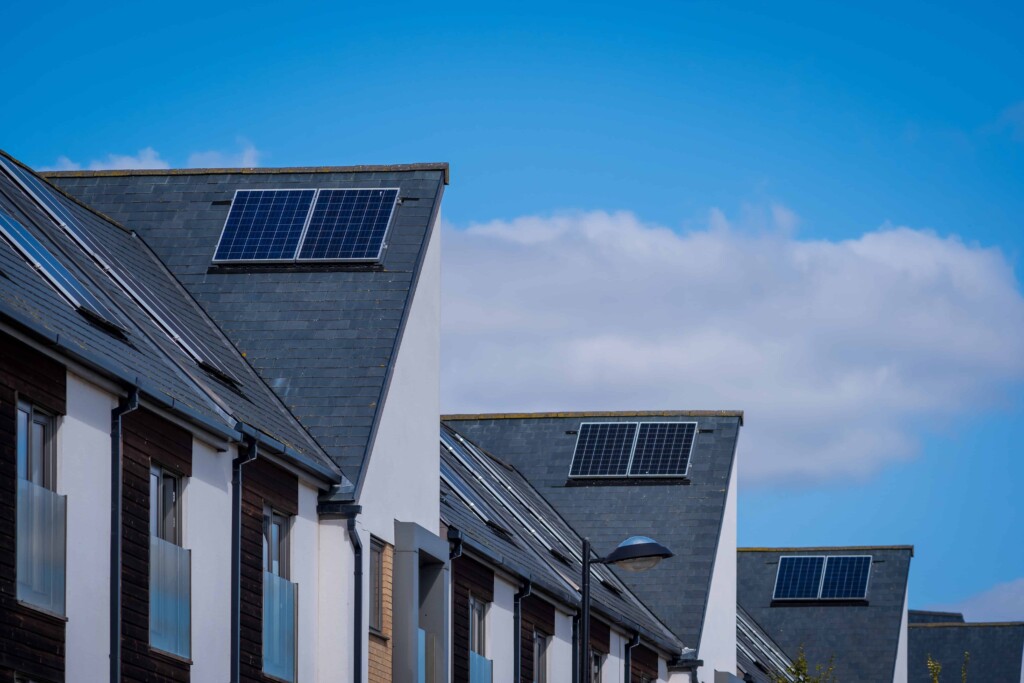
The new functional requirement L3 mandates on-site renewable electricity generation for all new dwellings, benchmarking solar PV coverage at 40% of each dwelling’s ground floor area. New homes should be generating their own electricity, and it is right that the standard now reflects that.
Combined with the shift to electric heating, the case for integrated energy management becomes considerably stronger. A home with a heat pump, solar PV, and a hot water cylinder holds real flexibility potential, but only if the systems operate together. That is the piece most new build specifications still miss. Individual components get specified in isolation, and the opportunity to optimise across the whole system is lost.
Hot water is particularly well suited to absorbing and storing renewable energy at low cost. A smart cylinder can soak up surplus solar generation during the day, shift its heating to cheaper off-peak periods overnight, and still deliver hot water on demand. For developers trying to demonstrate genuine energy performance to buyers, and for housing providers looking to reduce tenant bills, that is a practical and proven route to better outcomes.
What else is coming: HEM, SAP, and SSES
Two further developments are worth keeping on your radar.
The government is transitioning from SAP, the Standard Assessment Procedure used to calculate home energy performance and underpin Energy Performance Certificate ratings, to a new framework called the Home Energy Model, or HEM. The dual running period of at least 24 months between the two is the right call. HEM still needs significant development, and launching a compliance regime on top of calculation tools that are not finished helps no one. Mixergy cylinders are already recognised in SAP Appendix Q and listed in the Product Characteristics Database, so when HEM becomes the compliance standard, the performance data is already in place.
The Smart Secure Electricity Systems programme, known as SSES, is also progressing through Parliament. From late 2026, electric heating products including heat pumps and hot water cylinders will need to meet minimum smart functionality and grid stability requirements, functioning as Energy Smart Appliances capable of responding to grid signals and shifting demand. Mixergy cylinders are already designed for exactly this. When SSES comes into force, homes with Mixergy systems will already be compliant.
Where this leaves the industry
The Future Homes Standard sets the regulatory floor: low carbon heating, high fabric performance, improved ventilation, mandatory renewables. That baseline takes effect from March 2027. The homes that perform well beyond that floor will be the ones where systems are integrated rather than just co-located. A heat pump and solar panels are a start. Hot water intelligently connected to both, managed in response to occupancy, tariffs, and grid signals, is what turns a compliant home into one that genuinely performs. For developers, that means specification confidence and homes that deliver on their energy claims. For housing providers, it means visibility, evidence, and fewer problems to manage reactively.