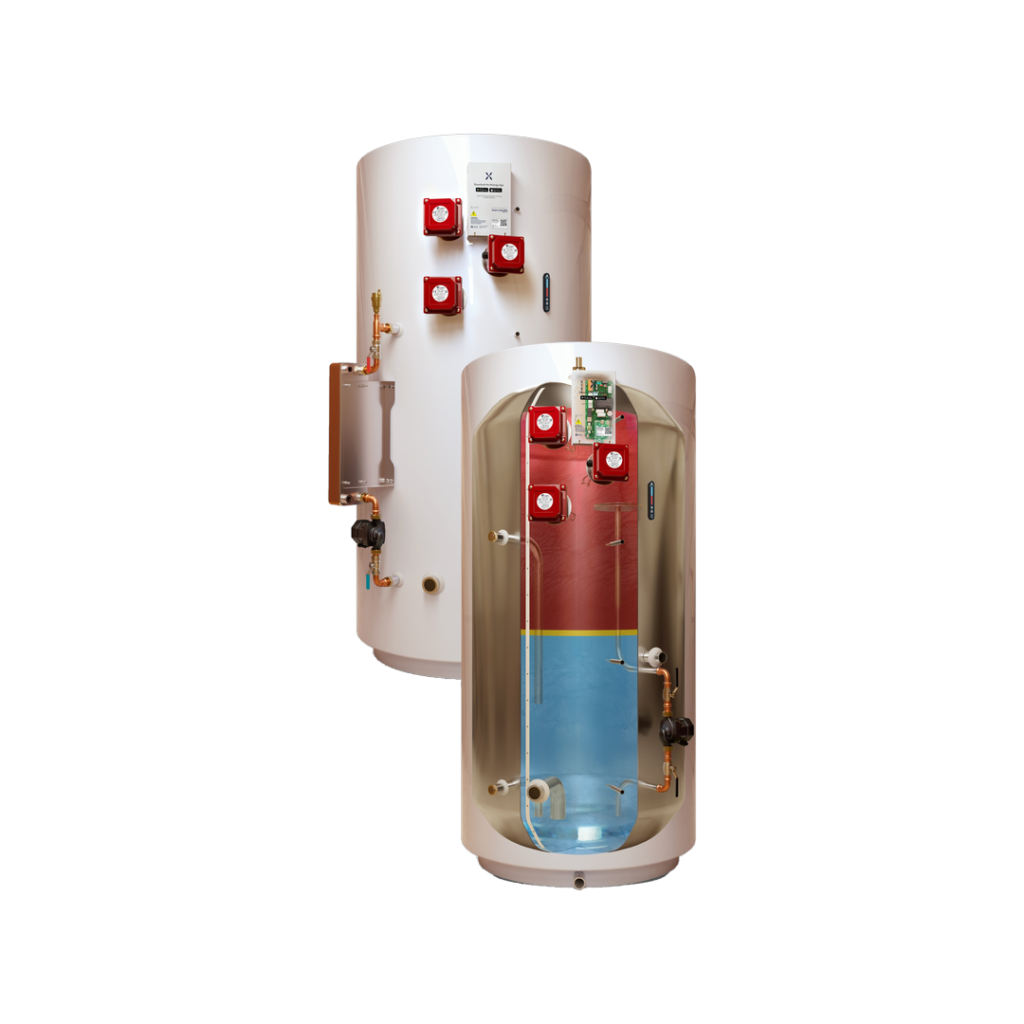
Most commercial hot water systems are sized for a day that rarely comes. Storage is sized to a design-day peak at full occupancy, then margin is added on top because a single thermostat can’t say how much hot water is actually left. The whole volume then has to be held at 60°C or above for legionella control, so every litre of spare capacity is heated and kept hot all day, waiting for demand that mostly isn’t there.
We can see the gap in our own data. Across a sample of 500 connected Mixergy cylinders of each size between 120 and 300 litres, typical spare capacity sits at 30 to 40%, and a 210-litre cylinder commonly serves less than 100 litres a day. Commercial plant is bigger, but the habit that produces the gap is the same one.
Why sizing defaults to the worst case
CIBSE Guide G gives designers demand rates per person and a typical peak profile, and it’s the right place to start. Its figures are deliberately conservative and assume design occupancy, though, and running the same building through Guide G, BS 8558 or a manufacturer’s sizing method gives noticeably different stored volumes. Faced with that difference in guidance, nobody wants to be the engineer whose building ran out of hot water, so the sensible move is to round up.
The controls then add another layer of margin. A conventional cylinder or calorifier is controlled from one thermostat, or at most a couple of sensors, and all they can report is whether the water at those points is hot.
Whether the cylinder is 80% full or 40% full is invisible to the controls, so there’s no reliable picture of how much usable hot water is in reserve, and the design adds extra volume to cover the uncertainty.
What oversizing costs
Every litre stored has to be heated and then kept hot. Raising a litre of water from 10°C to 60°C takes 0.058 kWh, and the bigger the cylinder, the more surface it loses heat through, so every extra litre adds to standing losses the system has to make up around the clock. Our fleet data puts the avoidable energy at 2 to 5 kWh a day for a cylinder in the 120 to 300 litre range, and while those are domestic-scale sizes, the same losses grow with every litre of oversized storage in a commercial plant room, every day of the year.
A larger cylinder is more expensive and takes up more plant room, which matters in older buildings where space is already tight. It also means a larger volume to hold at 60°C or above for legionella control, so oversizing quietly raises the energy cost of staying compliant.
What a full-length sensor strip changes
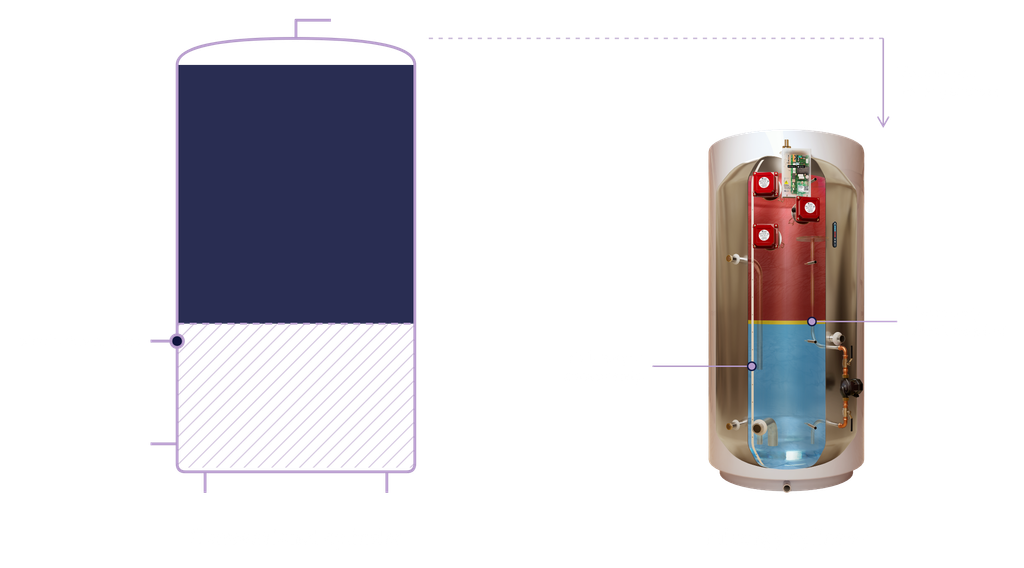
A Mixergy cylinder reads temperature along its whole height, so it knows how much usable hot water it holds at any moment, in the way a fuel gauge tells you more than a single warning light.
Our patented top-down heating works alongside it, delivering usable hot water up to 10x faster than a conventional cylinder heated from the bottom up, and stopping incoming cold water from diluting what’s already hot.
You heat what the building is likely to need, rather than holding the whole volume at temperature all day. The water it does store is held at 60°C or above, and a scheduled pasteurisation cycle takes the full cylinder up to temperature, so partial heating stays within HSG274 and ACOP L8.
That changes the sizing question. Instead of designing for an assumed peak, you can size against metered consumption, and we size to the 90th percentile demand day (the level that covers nine days in ten) On the remaining days, the full-height sensing shows exactly how much hot water is left, so the heat source or immersion can boost recovery before it runs short.
Designing to a defined percentile rather than an absolute worst case is a familiar risk-based approach, and it produces a smaller, cheaper cylinder with lower standing losses than the default tables. Where there’s no metered data, as on a new build, start from Guide G and refine against benchmarks from comparable buildings.
Our commercial range runs from 300 to 2,000 litres, with immersion options up to 54 kW, so a right-sized cylinder still has the power to recover quickly on a busy day. Larger immersions need the electrical supply to match, so check capacity early. The cylinder controls connect to the BMS via Modbus.
How it worked at Exchange Square
Twenty One Engineering met the oversizing question head on at Exchange Square, where the brief was to take the building’s hot water off gas without swapping in another oversized system.
They recovered waste heat from the lift motor room through a VRF unit and fed it into two 300-litre Mixergy cylinders, which store that heat when it’s available rather than heating on demand. They replaced 1,000 litres of previously installed storage. The building is saving around 600 kWh a week, and the system paid for itself in under a year.
Traditional designs were too big. Operational data gave us the right size for the system, and Mixergy’s smart storage enabled that flexibility.”
Phil Draper, Twenty One Engineering
Sizing a system the Mixergy way
Map the building’s daily demand profile and gather metered data on how much hot water it uses, then size the cylinder to what the building actually requires. Next, choose the heat source: an indirect plate heat exchanger from a heat pump or existing gas boiler, or direct immersion heating. Finally, agree the BMS strategy early, so the controls are designed into the system.
If you have a plant room due for replacement or a decarbonisation project, our commercial team can survey it and size the system against what the building really uses. Book a free survey, or book a free CPD session for your team.

