Mixergy and Split AC: a winning path to cool and decarbonise homes
At Mixergy, we are seeing increasing interest around our products being paired with split air conditioning systems. Recent testing at Mixergy’s R&D bungalow shows that a portable air conditioning unit uses around three times more energy than a properly installed split system to deliver the same cooling, despite both carrying an A rating. This raises major questions around which technologies are supported by the government and, in particular, the UK’s Boiler Upgrade (BUS) Scheme.
This blog follows on from our recent post about the R&D Bungalow, which has been set up to explore a number of open questions about electrifying UK homes, including the choice between monobloc (air-to-water) and split air-to-air heat pumps. This summer’s heatwave has provided useful evidence around this question as the UK faces more heatwaves in future.
Exploring the hidden penalty of portable AC systems
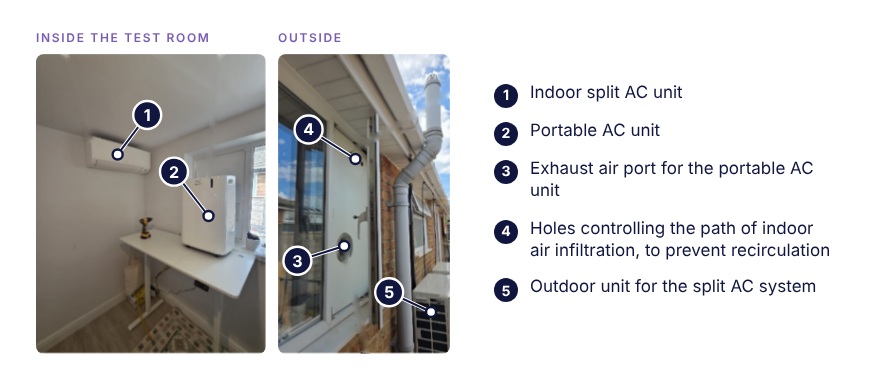
Test room to evaluate performance of split air-to-air versus portable AC units.
Our first blog noted that a portable unit appeared to use considerably more energy than a split system to keep a bedroom cool, this was based on eyeballing the electricity meter. We decided to explore this more rigorously and so we worked with Dr Nicole Miranda, a researcher at Oxford University, to compare a well-installed split system versus a portable unit back-to-back, in the same rooms, during June’s record-temperature heatwave.
The results of this work are currently under review for publication, but the punchline is that a portable unit used roughly three times more energy than the split system to deliver the same cooling. Perversely, both units carry an ‘A rating’.
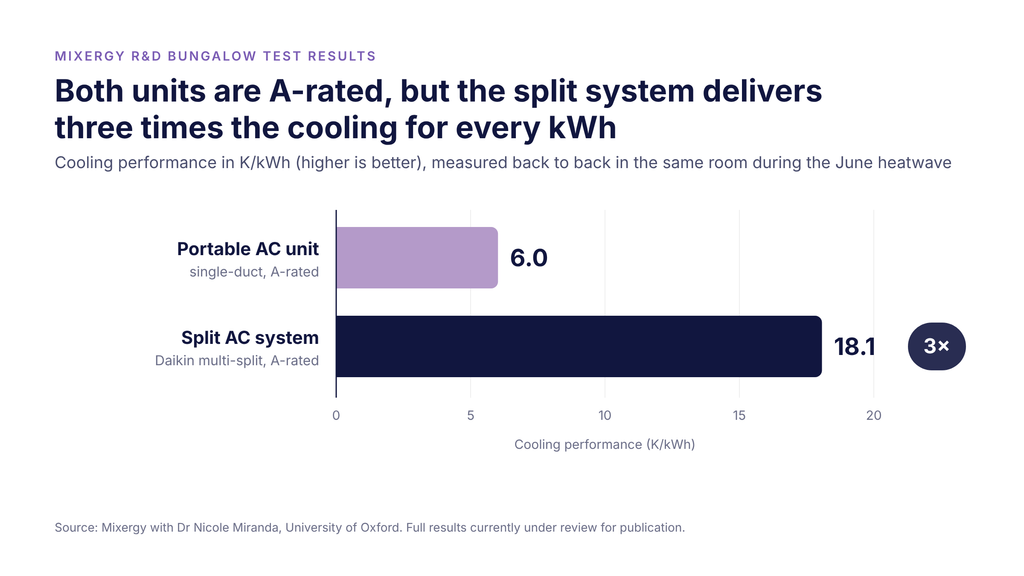
Split air conditioner’s performance: a properly installed Daikin multi-split versus a portable AC unit. Both are A-rated, yet the split is around three times more efficient.
Not only is the portable AC system highly inefficient, it is also very noisy, takes up floor space and is much less effective at cooling in comparison to a split unit (given that it is only capable of moving the bulk temperature of the room down by a few degrees at most).
In our paper, we go into the technical details around why this happens and reconcile a theoretical model against the experimental data. The difference in performance is due to the physical differences between split and portable systems. A split system transfers heat outdoors through refrigerant pipes, keeping conditioned air inside the room.
A single-duct portable unit rejects its heat by exhausting room air through a window. That air must be replaced, and during a heatwave it is replaced by warm outdoor air drawn back into the room. A significant share of the unit’s effort is therefore spent cooling air that has just come in from outside. In spite of this intrinsic penalty, these products are usually awarded an ‘A-rating’ when consumers come across them in major electrical retailers.
Why this matters, the heatwave trap
With an ever-increasing frequency of heatwaves, UK households are voting with their feet to go out and buy portable AC units. This makes perfect sense given that overheating impacts sleep quality, productivity when working at home and can create health risks for vulnerable individuals. However, when it comes to electrifying their home, the government is currently giving these households just one realistic option, monobloc heat-pumps coupled to a wet heating system. This leads to the following chain of events:
- A householder installs a wet monobloc heat pump, supported by a £7,500 Boiler Upgrade Scheme grant.
- A heatwave arrives, and the hydronic heat pump usually cannot provide cooling easily when paired with conventional wet heating systems without creating condensation.
- The household buys a portable AC unit on top of the heat pump that is around three times less efficient than a split system.
An air-to-air heat-pump on the other hand would have provided both heating and cooling at a much higher efficiency than a portable unit whilst being quieter, less disruptive to install and freeing up space in the home through the elimination of large radiators.
You may be thinking – ok, but what about underfloor heating which has more ‘inertia’ than the split system and can provide cooling without condensation? Bear with us, we are exploring this theme over the coming winter!
Better together: split air + smart hot water
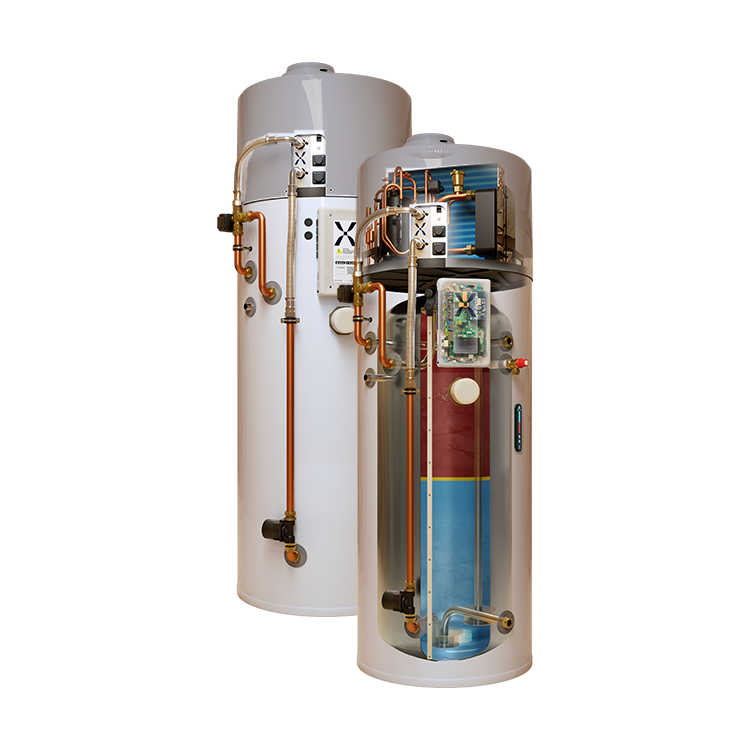
Great partners for split air: a Mixergy iHP, or a direct electric Mixergy tank with Flex Rewards, for the lowest cost hot water with fast recovery and high comfort.
Most split air systems do not provide hot water and this is required all year round. This is where Mixergy fits in. An air-to-air system combined with a Mixergy iHP is the highest performing product combination in the UK’s Standard Assessment Protocol (which drives Energy Performance Certificates).
Furthermore, Mixergy’s Flex Rewards scheme allows the cylinder to earn revenue for the household by shifting its heating to times when the grid has surplus power. Current schemes do not encourage this flexible combination in spite of this technology having been developed and made in the UK. We believe the government should support households who wish to decarbonize through Mixergy + split air, for many reasons:
- Health and productivity. Providing an effective cooling solution during heatwaves is good for health, sleep quality, cognition and productivity, particularly for people working from home.
- Grid impact. Portable units waste energy, cool less effectively and are noisy at night, when cooling matters most for sleep..
- Solar and storage. A home with solar panels and a battery can run split air largely on its own generation, so it need not add to grid demand.
When combining these benefits with Mixergy, we get the added benefits of highly efficient hot water production which flexes with the grid to earn money for the household.
What’s next?
Government should encourage split air conditioners combined with smart hot water, whilst funding is available, it is at a third of the level enjoyed by monobloc systems and is still pending MCS installation standards to go ahead.
Without this, households risk paying for wet systems (i.e. typical heat pumps that only feed radiators/emitters) and then buying inefficient portable units during heatwaves.
For most households in the south of the UK, where summers are getting hotter, smart hot water combined with split air offers a more consumer-friendly proposition.
Over the winter, we will compare Mixergy with split air and a battery against Mixergy with a monobloc heat pump flexing the thermal mass of the home, watch this space for results next year!

