Phase Change vs hot water heat pumps: what SAP 10 shows
Phase Change hot water systems are often described as heat batteries and are sometimes presented as a simpler, lower risk option than hot water heat pumps. That argument only matters if the system still complies with Building Regulations.
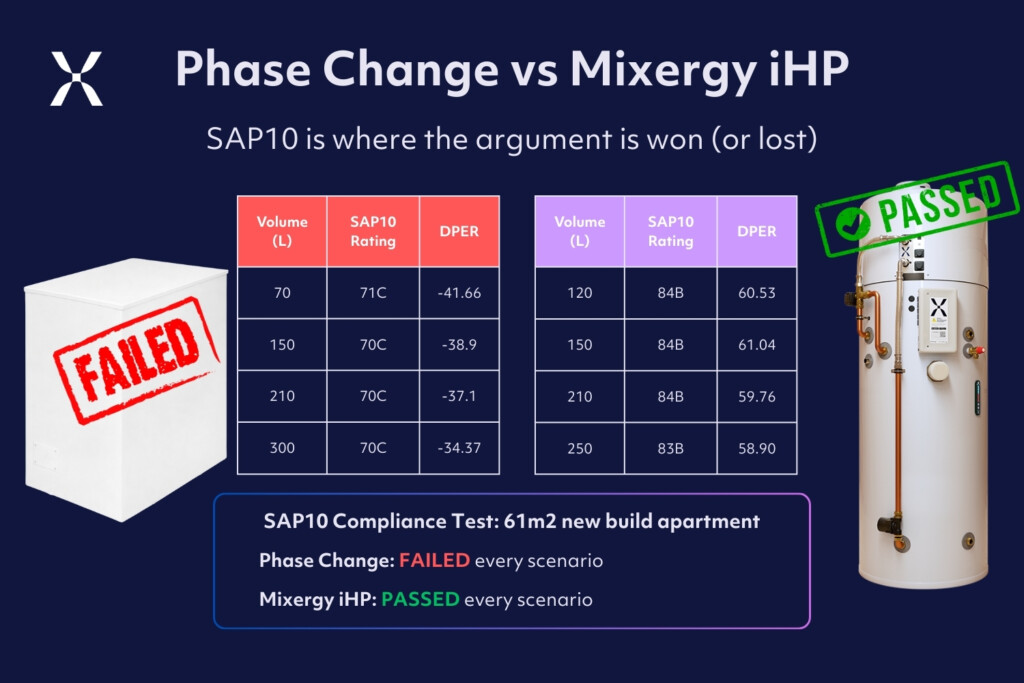
To test this properly, we modelled both approaches in SAP 10 for a typical new build apartment (61m2) and compared the results using the metrics that determine compliance.
How the comparison was set up
No solar PV was included. For apartment blocks of this size, roof area is limited and PV allocation per dwelling is often minimal or not viable. Excluding PV reflects a realistic design scenario and keeps the focus on the intrinsic efficiency of the hot water systems themselves.
Hot water demand was around 140 litres. Multiple product sizes were modelled for both technologies to keep the comparison fair.
Although this was a new build SAP comparison, the same efficiency difference would also appear in RdSAP, because the underlying issue is the same whether electricity is used directly or multiplied through a heat pump.
The SAP metrics that decide pass or fail
SAP compliance is determined by whether a dwelling meets its targets. Two of the key metrics are:
- the Dwelling Emission Rate
- the Dwelling Primary Energy Rate
Both must be no worse than their respective targets. Under SAP 10, electricity has a lower carbon factor than before, which can allow electric systems to meet emissions targets while still failing on primary energy.
What the modelling showed
In this dwelling:
- Every Mixergy integrated heat pump configuration passed SAP compliance
- Every Phase Change configuration failed
Phase Change systems performed comfortably against the emissions target. However, all of them exceeded the primary energy target by a large margin. Failing primary energy alone is enough to make the dwelling non-compliant.
SAP does not allow trade offs between these metrics.
Why the results differ
The difference is not about how heat is stored. It is about how electricity is converted into usable hot water.
Electrically charged Phase Change systems operate at close to one unit of heat delivered for each unit of electricity consumed. From a SAP perspective, this is direct electric hot water.
Integrated heat pump water heaters multiply electricity through a heat pump cycle. In this modelling, Mixergy iHP systems operate at a coefficient of performance well above three, which directly improves primary energy performance.
Conclusion
This SAP 10 comparison shows how decisively domestic hot water efficiency can affect compliance in all electric new build apartments. In this dwelling, integrated heat pump water heaters passed, while Phase Change systems failed on primary energy, even though emissions were acceptable.
There is also an important forward looking point beyond SAP 10. The Home Energy Model, which is being developed to replace SAP, is starting to explicitly recognise smart functionality in thermal energy storage, including smart hot water cylinders, alongside smart controls and demand management.
As the assessment framework evolves, smart hot water should be able to demonstrate lower primary energy and carbon than conventional cylinders by heating only what is needed, reducing standing losses and avoiding unnecessary reheats. The direction of travel is clear.
Book in your modelling workshop
In this free one-hour session, our trained team will walk you through smart hot water and how to model it well. You’ll receive a 1 hour CPD certificate for attendance.
Fill in the form below and we will get in touch to arrange a time that suits you.