
The next price cap rise hits residents in all electric homes hardest. Let's talk hot water.
The price cap rose 13% on 1 July, to £1,862 a year for Ofgem’s typical dual fuel household paying by direct debit, and it’s set to go up yet again in October. But that average is built on a home that heats itself with gas. What about homes that are going all electric, and what should we be worried about for residents in social housing?
Space heating stops in spring, but hot water runs all year, morning and night, and it accounts for around 18% of a household’s heat demand on the Energy Saving Trust’s figure.
An all-electric flat or home might use smart infrared panels or storage heaters for the space heating, which are great at managing the energy use. But the hot water is still being bought at the top rate every day of the year under the conventional specification, a direct electric cylinder heating its full volume at full price.
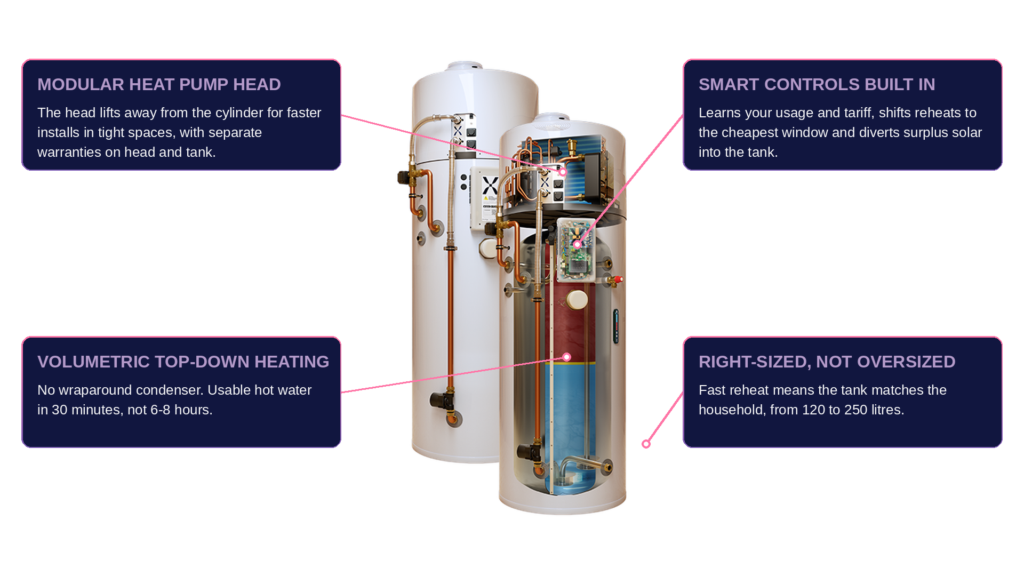
Our Mixergy iHP X was built for exactly this type of stock. A heat pump inside the cylinder does the heating, running up to 3x more efficient than direct electric, which is what claws back the premium an all-electric home pays for hot water.
Landlords looking for measures that move a resident’s bill this winter should look at how a cylinder swap does exactly that.
‘Heat what you need’ is where the savings are made
Every conventional cylinder has to bring the full volume up to temperature before any of it is usable. Ours heats only what the household will use, holds that portion ready, and lets it wait for a cheaper hour without anybody in the flat noticing.
Birmingham City Council put that control on nearly 1,000 Mixergy X cylinders across East Birmingham, on direct electric, working with Equans, and over two years the programme saved around £150 a year per household on the hot water.

How Birmingham City Council is meeting Net Zero goals with Mixergy
iHP X runs the same heat what you need control, but with the heat pump’s efficiency on top.
Recovery speed is the difference a resident feels every day, and size matters for retrofit
Heat pump water heaters are efficient, and the good ones are very efficient. But their published reheat times run in hours. Ariston’s Nuos Plus Wi-Fi 200D, for example, publishes a reheat time of 3h 59m to bring its full volume to 55°C. This is the kind of user experience that turns residents off the technology and loses their trust.
In our boost mode, iHP X delivers first usable hot water in under 30 minutes.
Part of that heat up time is sheer size. With the heat pump added on top, these can be very large cylinders. Because we heat only what the home needs, and faster, we can go smaller, supplying a 210L in place of a 250L depending on the set up.
Heat pump water heaters often aren’t considered for retrofit because of that oversizing, but ours is designed to fit into an airing cupboard where it can, with the swap-out of an existing cylinder in mind.
Where to learn more
We’re bringing an iHP X to ASCP26 at ICC Wales on 8 and 9 September, where you can see the cylinder for yourself and discover how much your tenants can save.
Or get in touch with the team below: