
Specifying smart hot water for low heat demand homes under the Future Homes Standard
When space heating demand falls, hot water demand doesn’t follow it down. Better fabric, airtightness and heat recovery can cut a new home’s heating load to a few kilowatts, but the occupants still shower, still run taps, still fill baths. In the best-performing Future Homes Standard dwellings, hot water becomes the largest single energy load in the house. That changes what a specifier should be asking of the cylinder.
Mixergy’s Pete McBride joined the Future Homes Hub podcast recently to discuss exactly this, alongside panellists from NIBE, Qvantum and Wondrwall, in an episode focused on heating solutions for homes with especially low space heating demand. The discussion covered exhaust air heat pumps and direct electric heating, and in both cases the hot water strategy turned out to be where the real specification decisions sit.
Storage is back, so size it properly
The Future Homes Standard rules out gas boilers, and with them the combi. Every new home needs hot water storage again, and the developer has to find space for it. The habit that needs breaking is oversizing.
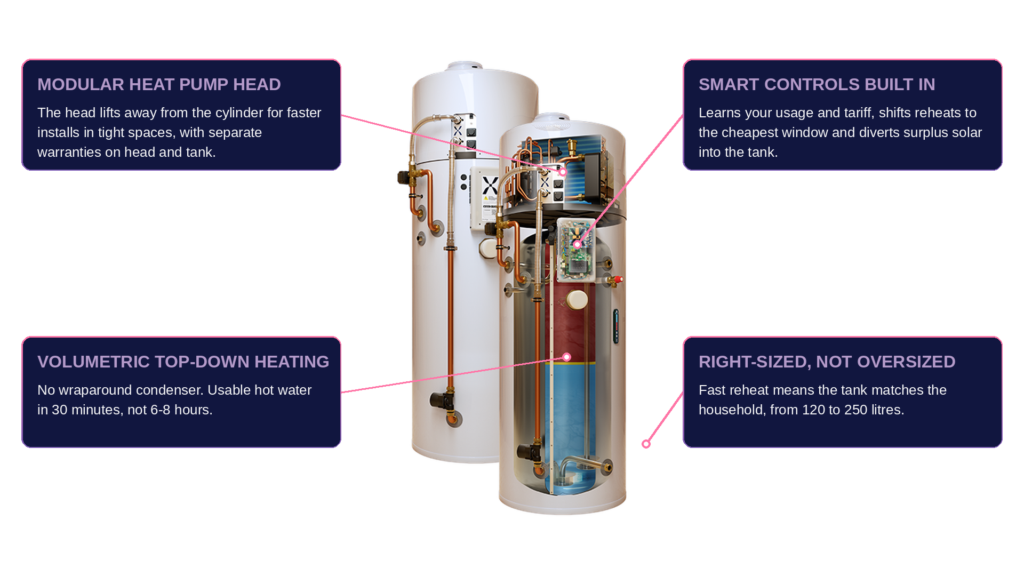
The reason integrated heat pumps cylinders often get oversized is reheat speed. A conventional integrated heat pump cylinder with a wraparound condenser and an internal unit rated under a kilowatt can take six to eight hours to reheat. The only way to guarantee the household never runs out is to fit a cylinder big enough to hold a full day’s hot water, which is how a two bed home ends up with a 250 litre tank. That means heating more water than anyone uses, which shows up in the energy bill and the carbon figures.
Fast reheat removes the problem. The Mixergy iHP X delivers usable hot water within 30 minutes because it heats the tank volumetrically, top down, rather than warming the whole volume through a wraparound coil. That lets the cylinder be sized to the home rather than to worst-case demand, with the range running from 120 litres up to 250 litres. A smaller, correctly sized cylinder in a smaller home costs less to run, takes up less of the compact footprint these dwellings have to work with and still copes with the morning everyone showers at once, because boost mode recovers it in half an hour.
Direct electric needs a smart cylinder even more
Direct electric space heating has a place in very low heat demand homes, particularly where fabric performance offsets its efficiency penalty against the notional heat pump specification. But direct electric heating is almost always specified with a integrated heat pump cylinder, because hot water is where a coefficient of performance near four earns its keep. If hot water is the dominant load in the home, and the space heating is running at a COP of one, the cylinder is carrying the efficiency of the whole dwelling.
The cylinder is an energy asset, not just a tank
The strongest argument for smart hot water is what it does with time of use tariffs. A household on an overnight rate might pay 7p per kilowatt hour between midnight and 7am and 28p outside it. A smart cylinder that learns the household’s usage patterns can shift its reheat into the cheap window automatically, which also tends to be when grid carbon intensity is lowest. Because the Mixergy tank measures its state of charge, it can go further and skip a reheat entirely when there’s enough stored hot water to cover the next day, heating from the lowest possible starting point for the best efficiency.
Solar PV makes the case stronger still. New homes are now built with panels on the roof, but without storage most of that generation exports straight back to the grid and the occupant sees little benefit. A cylinder with a PV diverter turns surplus generation into stored hot water instead.
Then there’s demand side response. The UK paid just under £1.5 billion in curtailment costs in 2025 to turn generation off when supply outstripped demand. Smart cylinders operating together as a virtual power plant can absorb that surplus, and households on dynamic tariffs are increasingly paid to do so. Legislation requiring smart, flexible assets in new homes is on its way, and a smart hot water cylinder is one of the cheapest ways to comply.
What to put on the spec sheet
For a low heat demand dwelling, the hot water specification should cover reheat time (usable hot water in minutes, not hours), a cylinder sized to the household rather than oversized as insurance, tariff-aware smart controls with machine learning, PV diversion, and demand side response capability. Modular designs where the heat pump head separates from the tank are worth favouring too, since they speed up installation in tight cupboards and allow separate warranties on the head and the cylinder.
The notional specification is guidance, not a ceiling. As Pete put it on the podcast, smart hot water is a low carbon energy asset for the home, and the specifiers who treat it that way will deliver homes with lower bills than the ones who treat the cylinder as a box to tick.
Specifying hot water for your next development?
Our team works with developers and specifiers every day on sizing, SAP performance and getting ready for Future Homes Standard projects.